
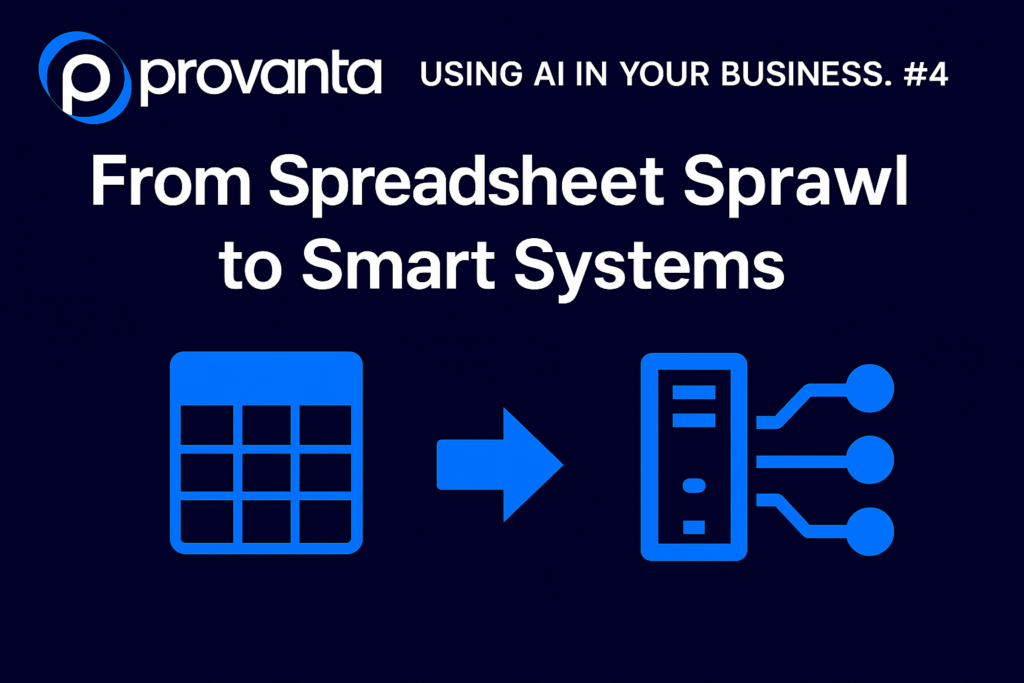
Using AI in Business. #4 From Spreadsheet Sprawl to Smart Systems
Every organisation has that folder. Inside it are countless spreadsheets with names like Quotes_v7_JP_Copy(2).xlsx. Formulas link across tabs and files. Macros run quietly, written by someone who left two years ago. It works—until it doesn’t.
Spreadsheets are great for exploration and quick wins. They’re poor as long-term business systems. Over time the “temporary” becomes the “critical,” and risk creeps in unnoticed. Maybe you’re already losing sleep..
Why spreadsheet-run businesses are risky
Vulnerable data. Spreadsheets have almost no data protection. It’s easy to delete a cell or a row with costly consequences. And when it comes to backups— which version was it?
Fragile logic. A single hard-coded number hidden in a formula can distort pricing, forecasts, or payroll. There’s nothing to prevent it.
Version chaos. Multiple copies circulate by email and chat. Which one is correct? Usually whichever was opened most recently.
Key-person dependency. One person knows the hidden ranges, the secret lookup sheet, the macro that fixes rounding. When they’re away, work slows or stops.
No audit trail. Who changed that formula and when? Spreadsheets don’t record it. In regulated environments, that’s a serious problem.
Security holes. Sensitive data gets copied to personal devices, shared externally, or stored without encryption. File access is simply “whoever has it.”
Process gaps. Approvals happen in email threads, comments, or casual requests. There’s no consistent workflow.
The impact isn’t theoretical. It shows up as missed revenue, delayed month-end, frustrated auditors, and teams stuck reconciling for days.
What an AI-generated system means in practice:
-
Understand the current model.
Define the workflow and capture it in a system with user logins, controlled access, and managed statuses. -
Generate a single source of truth.
Keep data in a proper database with consistent structure, audit history, and backups. The “truth” is now in one place, not scattered across dozens of files. -
Create the front end.
Forms mirror your current tabs but include validation, required fields, and instant feedback. Bulk upload and export are still available—Excel isn’t banned—but they’re controlled. -
Add workflow.
Approvals become explicit steps (Submit → Review → Approve/Reject) with notifications, SLAs, and audit logs. No more wondering if an email was seen. -
Build reporting you trust.
Dashboards pull from the single source of truth instead of stitched-together CSVs. Calculations are versioned and tested. -
Keep flexibility.
Ad-hoc analysis is still possible. Users can spin up saved views, run queries, and export to Excel for modelling—without breaking the system. -
Connect the edges.
APIs integrate with finance, CRM, and data warehouses. Manual copy-paste is gone.
“But our spreadsheets are complicated”.
Good. That means you’ve encoded real business logic. AI is useful precisely because it can read that logic directly: formulas, named ranges, cross-file references, even comments that explain intent. It won’t be perfect on day one, but it gets you 80–90% there quickly, and the last mile is far easier than starting from scratch.
What changes for your teams
- Less firefighting. Data issues surface immediately, not at month-end.
- Clear ownership. Every field, rule, and report has a named owner and history.
- Fewer keystrokes. Imports, de-duplication, and validation become background tasks.
- Confidence. People stop asking “Which version?” and start asking better questions.
Risk down, speed up
Moving from spreadsheet sprawl to a proper ted system isn’t just a tech upgrade; it’s a governance upgrade. You gain:
- Data integrity: Constraints and tests replace hope and habit.
- Security: Proper access control and encryption replace file-permissions roulette.
- Traceability: Every change is logged. Audits become boring (in a good way).
- Resilience: No single point of failure called “Sandra’s laptop.”
Conclusion
Spreadsheet-based systems are a real pain, but until now they have been hard and expensive to replace. The advent of AI and its ability to generate systems quickly changes the equation. It’s time to think again—you can afford a proper system.
Provanta are the experts at using AI to generate business systems quickly and cost effectively. Contact us to learn more.
A final thought
Spreadsheets helped you grow. They’re familiar, flexible, and empowering. But when they become the system of record, they quietly turn into risk. An AI-generated solution doesn’t take flexibility away; it adds the safeguards you’ve been missing and gives your team back time to think.
If your file names include “final_v12,” you already know it’s time.
Let’s Talk
Want to learn more? Let’s connect.
Jim.Parsons@provanta.ai